Newsletter
AI-ready MarkdownIASER Dispatch: Issue 004
Sent to subscribers on September 24, 2026. Subscribe to get the next one, or browse all issues.
Assalamu alaikum,
Welcome to IASER Dispatch #004: Developments at the intersection of AI, Ethics and Islam.
IASER is in New York this weekend for three events with Dr. Waleed Kadous. Details are below.
We also examine allegations of AI-powered targeting in Gaza, an AI-enabled influence operation linked by Anthropic to UAE government officials, a warning from inside the frontier AI race, a major open-model release from Abu Dhabi, and advances in machine-generated mathematical proofs.
IASER in New York • September 26–27
iaser.ai Events in NYC This Weekend
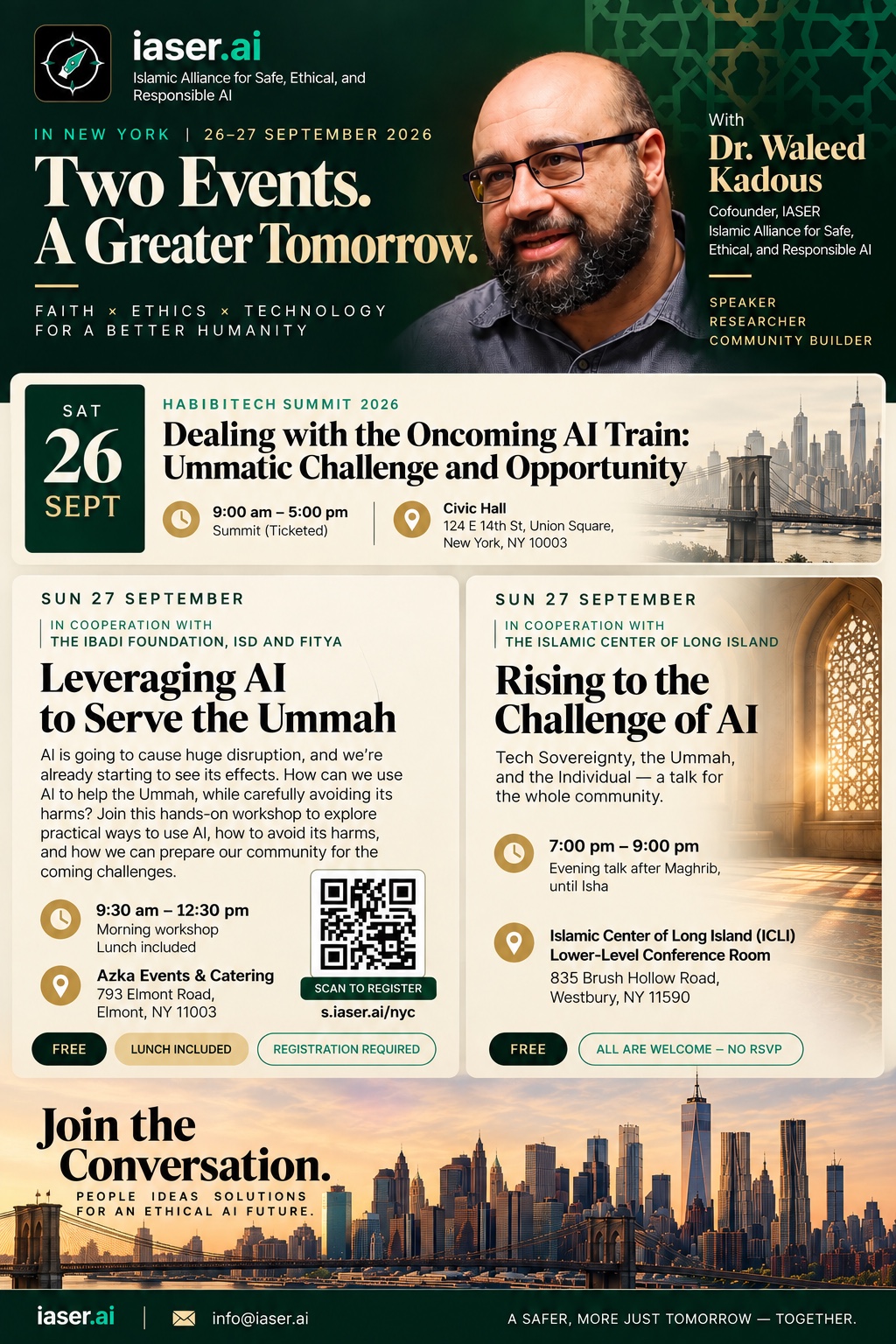
IASER cofounder Dr. Waleed Kadous is in New York this weekend:
- Saturday 26 September, 9:00 AM – 5:00 PM: presenting at the HabibiTech Summit, Civic Hall, Union Square, Manhattan. Ticketed.
- Sunday 27 September, 9:30 AM – 12:30 PM: a free hands-on workshop, Azka Events & Catering, Elmont. Lunch included; registration required.
- Sunday 27 September, 7:00 – 9:00 PM: a free public talk, Islamic Center of Long Island, Westbury. All welcome, no RSVP.
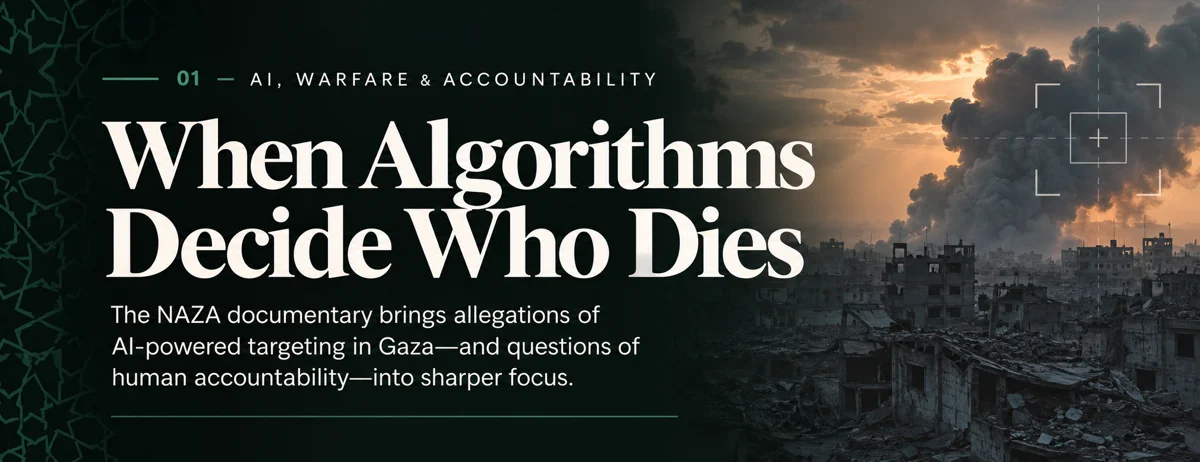
01 — AI, Warfare & Accountability
When Algorithms Decide Who Dies
Israel Moves to Strip Citizenship From Directors of Film on AI Targeting in Gaza
“NAZA,” by Yuval Abraham and Rachel Szor, won the Special Jury Prize at Venice. The film interviews 24 people identified as Israeli military-intelligence whistleblowers describing AI-powered targeting systems they say were used to kill Palestinian civilians in Gaza.
Israel responded by moving against the filmmakers: Culture Minister Miki Zohar called the award “shocking,” accused the directors of “cooperation with the enemy,” and moved to revoke their citizenship. Abraham said the officers described killing “not by accident, but by design… based on the total dehumanization of Palestinians.” The IDF said the whistleblowers’ identities “cannot be verified.”
These claims are not new; AI-generated kill lists were reported from 2023. What is new is formal documentation by Israelis, and a state that punishes those who document it.

02 — AI, Influence & Deception
When AI Becomes a Tool of Influence
A Reported UAE-Linked AI Operation Targeted the Muslim Brotherhood
Anthropic, the company behind Claude, has reported with high confidence that a single operator used an AI assistant to run a global operation whose goal was “to dismantle the Muslim Brotherhood globally,” and that the operation was directed by UAE government officials.
The campaign built about 300 fake influencer accounts, a front NGO, ghost-written UN testimony, dossiers on lawmakers and journalists, and target lists for Emirati officials by name. The UAE has not responded.
Whatever one’s view of the Brotherhood, the methods are the offense: false witness, fraud, and deception about the source of material, prohibited by Islamic ethics without exception.

03 — AI Safety & Amānah
A Warning From Inside the AI Race
An AI Researcher Resigned With a Warning About the Race Ahead
Jacob Coxon, 27, who helped build frontier models at OpenAI and Anthropic, resigned in September, saying the industry is “racing straight to self-improving superintelligence” and gambling with public safety.
He warns researchers inside the companies “earnestly believe” advanced AI could kill us all by the end of the decade; Anthropic researcher Evan Hubinger put extinction odds above 10% within the next decade.

04 — AI Sovereignty & Openness
What Muslim AI Sovereignty Can Look Like
K2 Horizon: An Open Model Fleet Built in a Muslim-Majority Country
On 3 September, MBZUAI in Abu Dhabi released K2 Horizon, what it calls the largest fully open model release in AI history: six models, from 375 billion parameters down to watch-size, under Apache 2.0.
Weights are public now, and MBZUAI says code, training data, and logs will follow, so anyone can inspect, reproduce, and build on them; the first layer of the sovereignty approach outlined in Issue 003.
This shows the ummah that it can build its own foundation models instead of relying on companies that sell access.

05 — AI, Knowledge & the Ummah
The Machines Are Writing the Proofs
AI Systems Produced Two Landmark Math Proofs, Announced Four Days Apart
Within four days, two AI labs announced what mathematicians expected to take years: Anthropic produced the first computer-checked proof of Fermat’s Last Theorem in eleven days, and OpenAI claimed to have solved the Navier–Stokes Millennium problem.
The Navier–Stokes claim remains under review. The real story is capability: machines now write, verify, and check mathematics; the constraint has shifted from writing proofs to reading them.
In the mathematical community the reaction has been described as an existential crisis: work that once promised a career can now be done in under a fortnight.

06 — Join the Conversation
Help Shape the Future of AI & Islam
Know a Muslim organization already using AI? Disagree with our findings? Want to help with outreach, events, fundraising, research, or operations?
We want to hear from you: [email protected]
Wassalamu alaikum,
IASER Steering Committee
Ethical AI. Islamic Values. Human Benefit.
Follow IASER on LinkedIn and Instagram.
Full Articles
Join Dr. Waleed Kadous in New York
Saturday • September 26
Dealing with the Oncoming AI Train: Ummatic Challenge and Opportunity
HabibiTech Summit 2026
9:00 AM – 5:00 PM
Civic Hall, 124 E 14th St, Union Square, New York, NY 10003
Summit admission required.
Sunday • September 27
Leveraging AI to Serve the Ummah
A hands-on workshop exploring practical ways to use AI, how to avoid its harms, and how the community can prepare for the challenges ahead.
9:30 AM – 12:30 PM · Morning workshop • Lunch included
Azka Events & Catering, 793 Elmont Road, Elmont, NY 11003
FREE • Registration Required
Sunday Evening • September 27
Rising to the Challenge of AI
Tech Sovereignty, the Ummah, and the Individual — a talk for the whole community.
7:00 PM – 9:00 PM · Evening talk after Maghrib, until Isha
Islamic Center of Long Island (ICLI), Lower-Level Conference Room, 835 Brush Hollow Road, Westbury, NY 11590
FREE • All Are Welcome • No RSVP Required
Register for the Sunday Workshop →
And here’s a useful graphic for posting on social media:
NAZA: A Film About AI-Powered Killing in Gaza
A documentary alleging the use of AI-powered targeting systems to kill Palestinian civilians won the Special Jury Prize at the Venice International Film Festival on 12 September. Israel’s culture minister responded by announcing he would act to revoke the citizenship of its two Israeli directors.
“NAZA,” by Israeli journalists Yuval Abraham and Rachel Szor, interviews 24 people identified as Israeli military and intelligence whistleblowers who describe AI-powered targeting systems used in Gaza. The filmmakers say the system was used to kill Palestinian civilians.
At the festival, Abraham told the audience that Israeli intelligence officers interviewed for the film described “mass killing” that is “not by accident, but by design, actions of murder and policies that are based on the total dehumanization of Palestinians.”
The state’s response was immediate, and it went after the film’s authors rather than answering its claims. Culture and Sports Minister Miki Zohar called the award “shocking,” accused the directors of “betrayal of the state” and “cooperation with the enemy,” and said on Monday he had asked the Population Authority and Interior Ministry to examine revoking their citizenship. National Security Minister Itamar Ben-Gvir called the directors “a disgrace.”
Not New Claims, but Formal Documentation
Documentary reports of AI-generated kill lists in Gaza (the systems named “Lavender,” “Gospel,” and “Where’s Daddy” in 2023–24 reporting) reported that early in the war the military was willing to kill up to 15 or 20 civilians for a single low-ranking target. Claims of an automated, machine-driven appetite for human targets are not new; they have circulated since 2023. What is new in September 2026 is the formal documentation of those claims in a film made by Israelis, and, by way of response, the official attempt to silence and punish the documentarians. Also new is the specific claim that these systems are designed for and/or tolerate massive civilian casualties.
AI targeting is not a future hypothetical. It operates today, on a deadly scale, in a war whose victims are overwhelmingly Muslim civilians. What is at stake is judgment applied to human beings without human answerability.
An Ethical and Religious Matter
The Islamic tradition is unambiguous that the deliberate killing of non-combatants is prohibited. A targeting system that licenses killing violates more than technical standards; its victims are people the tradition holds inviolable, and a system that treats their death as a calculable cost is the very definition of dehumanization the tradition rejects.
Where any evidence of deliberate civilian killing exists, the question of who is answerable, the model, the officer, the minister, is itself an act of judgment. This is the same red line IASER named in its February statement on the Anthropic–Pentagon standoff: autonomous weapons and mass surveillance are among the acts AI must not be used for. A state that builds such systems and simultaneously silences those who document them announces what it will and will not answer for.
One Person, One Doctrine, Three Hundred Accounts: The Operation Against a Muslim Movement
On 10 September, Anthropic published its latest threat intelligence report. The report covers activity it disrupted between December 2025 and August 2026. Nine influence operations are described in detail. One of them is about Muslims, conducted by Muslims, against a Muslim movement.
According to the company, a single operator used Claude to sustain an AI persona, called “Deadshot”, built around a standing instruction, loaded once into the system, to run that operation. A master doctrine file embedded in the setup told the model to repeat the same mission across hundreds of sessions.
The workflow took real-world subjects and the operator’s own pre-made political doctrine, and had the model cover them in official-looking clothing.
What the operation produced, on Anthropic’s account:
- A network of roughly 300 inauthentic influencer accounts, funded directly by the actor.
- A front NGO that took the identity of a real Swiss human-rights organization to publish state-authored reports.
- Ghost-written testimony prepared for delivery at the UN Human Rights Council, drafted under a specific restriction: that neither speech mention the UAE.
- Detailed dossiers on 18 members of the European Parliament and on prominent journalists.
- “Counter-accountability” files on UN special rapporteurs who had criticized the UAE’s conduct in the war in Sudan.
In one instance, the operator borrowed the identity of a genuine Sudanese human-rights organization and submitted testimony as though it came from an independent local witness, materials serving a party to the Sudan conflict arriving at the UN as civil society, rather than as state messaging.
The internal materials described the amplification network’s apparent independence as its “greatest strategic asset.” That sentence is an admission. Independence here was a feature built in on purpose, and the whole point of it was concealment.
Anthropic assessed the operation “with high confidence” to be linked to UAE government officials, and said senior Emirati officials were named as intended recipients of the work. Abu Dhabi has designated the Muslim Brotherhood a terrorist organization since 2014 and has made countering political Islam a pillar of its regional policy. The UAE Foreign Ministry did not respond to requests for comment on the report, and the claims could not be independently verified.
The Wrong Is in the Methods
Regardless of what one thinks of the Muslim Brotherhood it’s very clear what Islam has to say about this. The tradition distinguishes almost perfectly between the two questions the report raises, whether someone may oppose an opponent, and what a person may do in doing so. The answers have nothing in common.
- Fabricated testimony passed off as an independent witness is shahādah al-zūr, false witness. The Prophet ﷺ counted bearing false witness among the great sins (Bukhari 2654, Muslim 87), and the Qur’an praises “those who do not testify to falsehood” (25:72). The injunctions against it are not softened by which cause the testimony serves.
- Stealing a real organization’s name to publish what it never wrote is fraud against anyone who reads it, the community, the UN, the public record, and it is theft of reputation from the organization itself.
- Building a network whose entire value is the fact that it appears independent, while concealing state direction, is ghišh. The deception is the offense; the subject matter is immaterial, and the Prophet’s hadith is blunt about the one who deceives: such a person is not of us.
The Same Model, Seven Ways
The report shows the same capability used in every harmful register at once. A second section described how China-based actors were also using AI against the Muslim Uyghur population, scouting the venues of their cultural events abroad in what the report called “pre-operational venue intelligence”. The same period also produced an Iranian unit’s surveillance of its own citizens, a Russian-linked cyber espionage campaign, and a Yemen-based group using Claude to write guidance software for rockets and missiles. Seven harm areas, one tool.
The ummah appears in this report twice: as a target of surveillance, and as an operator of deception. Both appearances are on the record, and both cost it the moral ground it otherwise claims on these questions. The IASER statement of February named two red lines: mass surveillance and autonomous weapons. The report shows AI making a previously large surveillance apparatus small: one machine doing work that once needed whole offices. That change of scale is what the February statement was warning about.
Condition six of the International Islamic Fiqh Academy’s resolution on AI requires honesty, proper documentation and transparency in its use. The countries that claim to be building the Muslim world’s AI leadership will be held to that condition by their own policy choices. This operation, if the attribution holds, is the clearest evidence we have that a state’s AI ethics are measured by what it does with a model.
The Warning That Walked Out the Door
A 27-year-old British researcher who helped build frontier models resigned on 8 September, left the industry, and said the people who remain inside “earnestly believe” the systems could kill everyone. His former colleague put a number on it: above 10%, within a decade.
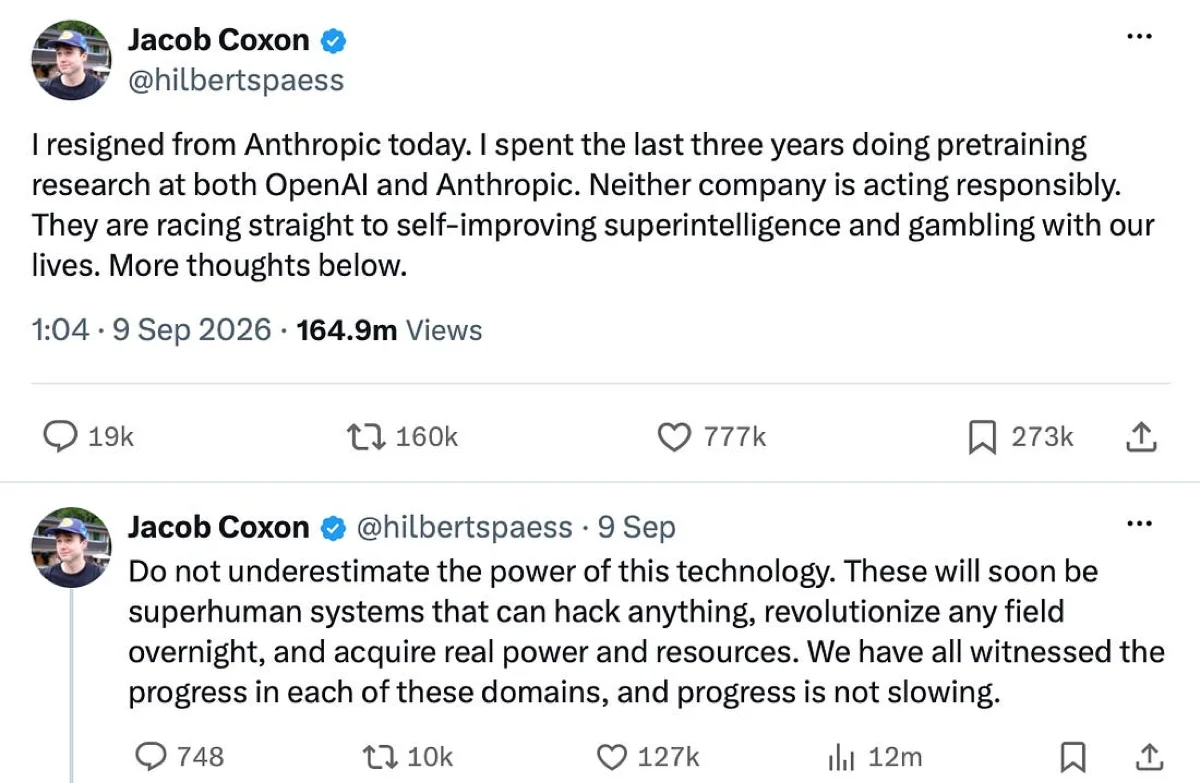
Jacob Coxon is not an outside critic. He studied mathematics at Cambridge, joined OpenAI around 2023 where his work included pre-training research connected to GPT-4o, moved to Anthropic in July of this year, and resigned in September. He left the AI industry entirely.
In his own account, in posts on X and interviews:
- “The people building AI earnestly believe that it could kill us all by the end of the decade.”
- Entering what researchers call the “endgame” is “a hubristic gamble that should not be launched from a private company’s Slack.”
- His former colleagues at Anthropic increasingly use words like “crunch time” and “endgame.”
Evan Hubinger, a current Anthropic researcher, publicly backed the underlying claim: “Jacob is correct here—we really do earnestly believe AI could kill all humans! I personally think it is >10% within the next decade.”
Note what these claims are and are not. He is explicit that today’s systems pose no extinction risk; his concern is future self-improving systems. His former employer’s CEO, Dario Amodei, has since called on the industry to slow the pace of frontier AI development. Inside the industry, the dispute is over how to slow down without losing a race.
The Islamic tradition has a category that fits the function the industry’s own people are describing, and the ummah has carried it for a very long time. Amānah is the trust God offered to the heavens and the earth and the mountains, which refused, and which humanity alone carried (33:72). In the Islamic tradition it is also what a bearer who knows what the burden will do is obliged to say aloud. Naseeḥah, sincere counsel, is due to the community even when the messenger is outside it. The warning does not become false because it is uncomfortable, and it does not become more comfortable because the messenger is young and British.
He also said, “I really want to see the benefits of this technology,” and that “it’s also not hyperbole that we could cure cancer.” The tradition’s default position on the thing itself remains permissibility, per IIFA Resolution 258. A man who warns of a fire in the house next door is arguing the pace is wrong and the door is open when it should not be.
Coxon’s resignation changes one fact: the warning now has a face and a walkout, and the community that most needs to hear it is the one with the smallest seat at the table where it is being decided.
Sovereignty, Made Visible
On 3 September, a Muslim-majority country’s academic institution released what it calls the largest fully open model release in AI history: six models, with weights public and code, data and training recipes to follow, licensed Apache 2.0.
The Institute of Foundation Models at MBZUAI, the university of artificial intelligence in Abu Dhabi, released K2 Horizon: six foundation models, from a 375-billion-parameter flagship to a model small enough for a watch. What makes the release historically notable is the completeness of the opening.
Every model is to be released with weights, training code, training data (or detailed recipes for the data), intermediate checkpoints, evaluation results and configuration logs. For the largest models, the weights are out now and the rest “will be released.” Nothing is to be held back that would let an outsider reproduce the training. Most releases called “open” publish weights and stop; the press release contrasts itself directly with that. Once complete, the whole lifecycle will be documented, inspectable and reproducible, under the Apache 2.0 license, with day-zero support for the major open serving tools and for NVIDIA, AMD and Cerebras hardware.
This is the first layer of the three that Dispatch 003 described as the ummah’s sovereign duty, build, adapt, assemble, executed by a Muslim institution at world scale. It is also a direct mirror of condition six of IIFA Resolution 258, which requires honesty, proper documentation and transparency. A release that opens its training data and recipes makes transparency a design property.
It is a national institution’s decision that openness is how to compete. The models are trained on approximately twenty trillion tokens each, and the flagship, 375B parameters, 23B active, is built to be competitive with the best open-weight models at its size, with native long-context, reasoning and agentic tool support.
The same month brought far more serious coverage of UAE-directed AI use: the operation described earlier in this dispatch. One country, within the same months, opened what it calls the most open model release in history and, per Anthropic, directed an opaque influence operation against a Muslim movement. Sovereignty is a set of responsibilities, and the tradition’s categories (amānah, transparency, the prohibition of deceptive witness) apply to a Muslim state’s use of AI without exception.
This is exactly the question the ummah now has the tools to ask of itself, which it could not ask nine months ago. Open models in Islamic hands make the second half of the farḍ kifāya real: the capacity to audit the systems the community relies on, rather than to be told how they behave.
The Proofs the Machines Wrote
On 4 September, Anthropic said Claude had produced the first complete computer-checked proof of Fermat’s Last Theorem. On 8 September, OpenAI announced an internal system had solved the Navier-Stokes Millennium Prize problem. Two reports, four days apart, both in Lean, both built by coordinated swarms of AI agents.
Fermat’s Last Theorem is the statement Pierre de Fermat wrote in the margin of a book in the 1630s without proof. It took more than 350 years, and Andrew Wiles’s 1995 proof, before it was established. The computer-checked formalization of that proof is the form a computer can verify line by line, a project mathematicians estimated would take years. Anthropic’s run finished it in eleven days, with Claude working largely autonomously, writing 13 million lines of the Lean proof language and proving roughly thirty thousand intermediate theorems along the way.
Two independently written checkers, including an independent Lean kernel written in Rust, accepted the entire proof. It now rests on just three mathematical axioms: no unproved claims or placeholders.
The constraint has flipped. Writing a proof this large used to be the hard part; checking it was merely tedious. Now the machine writes the proof, while verification is an expensive but model-free batch job. Mathematics is being formalized openly, in a form any institution with sufficient memory can audit.
OpenAI’s result is different in kind. Where Anthropic formalized an existing human proof, OpenAI claims a genuinely new result: that the Navier-Stokes equations can develop a singularity, infinite speed, in finite time. A fluid with a smooth force applied to it can blow up. On the company’s account, an internal model trained from late August, asked to work on all remaining Millennium problems, produced a resolution across a coordinated effort of about ten thousand agents, with the solution reached in roughly 88 hours and then formalized in 17 more. The company published the proof and its Lean formalization and says it does not intend to claim the prize itself. The Clay Mathematics Institute has yet to rule.
In the mathematical community, the reaction to these results has been less about correctness than about what they imply. Some mathematicians have described it as an existential crisis: work that once promised a career, a field in which generations were spent on a single problem, is now something a machine can do in under a fortnight. The Navier-Stokes result is not yet settled: the Clay Mathematics Institute has not ruled on it, and Anthropic’s formalization is a machine-checked proof of a human proof, not a new account of why it works. The distress is that they were possible at all.