---
title: "IASER Dispatch: Issue 005"
date: "2026-10-14"
type: "newsletter"
canonical: "https://iaser.ai/dispatch/005"
summary: "A ghost think tank built for chatbots, the Muslim World League's AI plans at the UN, AI in Islamic education, and the shift from chatbots to agents."
---
# IASER Dispatch: Issue 005
**Assalamu alaikum,**
Welcome to **IASER Dispatch #005**: Developments at the intersection of AI, Ethics and Islam.
This issue covers trying to manipulate AI to adopt particular positions, how the Muslim community is responding to AI and how to use it for education, and the shift from chatbots to agents that can act and what that means.
---
[](#hanover)
Story 01 · AI Influence
## Israel's Ghost "Think Tank" Was Built So Chatbots Would Read It
AI models learn from text on the internet, so whoever controls that text can change what the models say. Israel is now trying to do this, and the contracts are public.
In one week in August, the Hanover Institute for Public Policy published more than 120 reports, over half a million words. It has no legal existence, address, named staff or bylines. Its titles are questions people ask chatbots, like "Is Israel Carrying Out a Genocide in Gaza?" Piro Inc., working through Havas Media Germany, built it for Israel's Government Advertising Agency (LaPam), for about $1 million.
The wider campaign includes Brad Parscale's Clock Tower X, under a roughly $46 million contract to place "websites and content to deliver GPT framing results on GPT conversations." Several of its sites show up hundreds of times in Common Crawl's July index, which supplies training data. Hanover's reports came too late for that crawl.
Whether it changed any answers is unclear. The Guardian saw ChatGPT surface a few Hanover reports, with a warning about who funds them. Novara Media found that ChatGPT, Claude and Perplexity did not cite Hanover at all.
**[Read the full article →](#hanover)**
---
[](#mwl)
Story 02 · Institutions
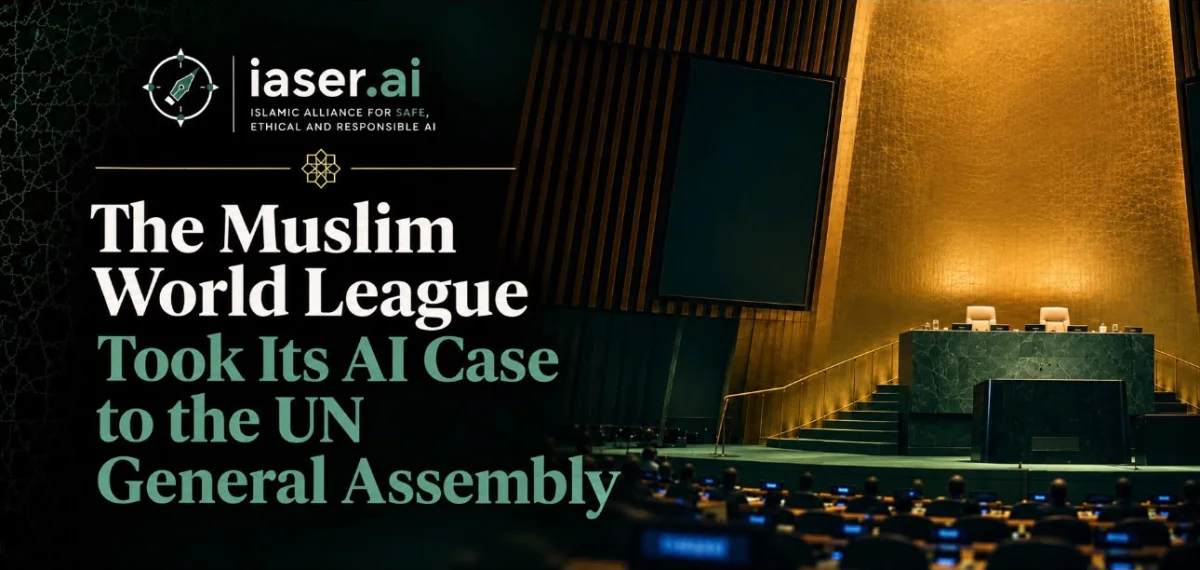
## The Muslim World League Took Its AI Case to the UN General Assembly
On 22 September, the Muslim World League hosted "AI for All: Faith, Human Dignity and Artificial Intelligence" during UN General Assembly high-level week, with the support and participation of the UN. On stage: MWL Secretary-General Sheikh Mohammed bin Abdulkarim Al-Issa, UN High Representative Miguel Ángel Moratinos, and OIC Secretary-General Ismail Ould Cheikh Ahmed, alongside religious leaders, representatives of US AI companies, the World Bank, and American universities.
The meeting recommended that the UN Alliance of Civilizations develop an "Alliance of Civilizations Code of Ethics for AI," with a committee that would include religious leaders, intellectuals, educators, legislators, and technology companies. Moratinos said the Alliance was ready to take it up.
Al-Issa also announced plans for an AI laboratory built with technology companies, for digitizing Islamic and Arabic sources so AI companies can use them, and for a unit to monitor and correct translation errors. His argument: mistranslations of Islamic texts and scholarship have produced mistaken perceptions. At the same meeting, MWL officials stressed that many current AI ethics discussions are dominated by Western Christian and secular frameworks and must include Muslim civilizational perspectives.
**[Read the full article →](#mwl)**
---
[](#education)
Story 03 · Education
## AI in Islamic Education: Opportunities, Risks and Responsible Use
Generative AI is beginning to play a role in Islamic education, from helping with lesson planning and teaching materials to supporting Qur'anic learning and personalised education. A recent systematic review in *Discover Artificial Intelligence* looked at how this technology is being used and the challenges that come with it.
The review found that AI can be a useful support tool, but it also flagged concerns about inaccurate information, unreliable references, privacy, and overdependence on AI. At the same time, a growing number of tools are being developed specifically around Islamic sources, offering a more focused approach than general-purpose AI.
For the Ummah, the question is not just whether AI should be used for Islamic knowledge, but how to keep it grounded in Islamic sources.
**[Read the full article →](#education)**
---
[](#agents)
Story 04 · AI Agents
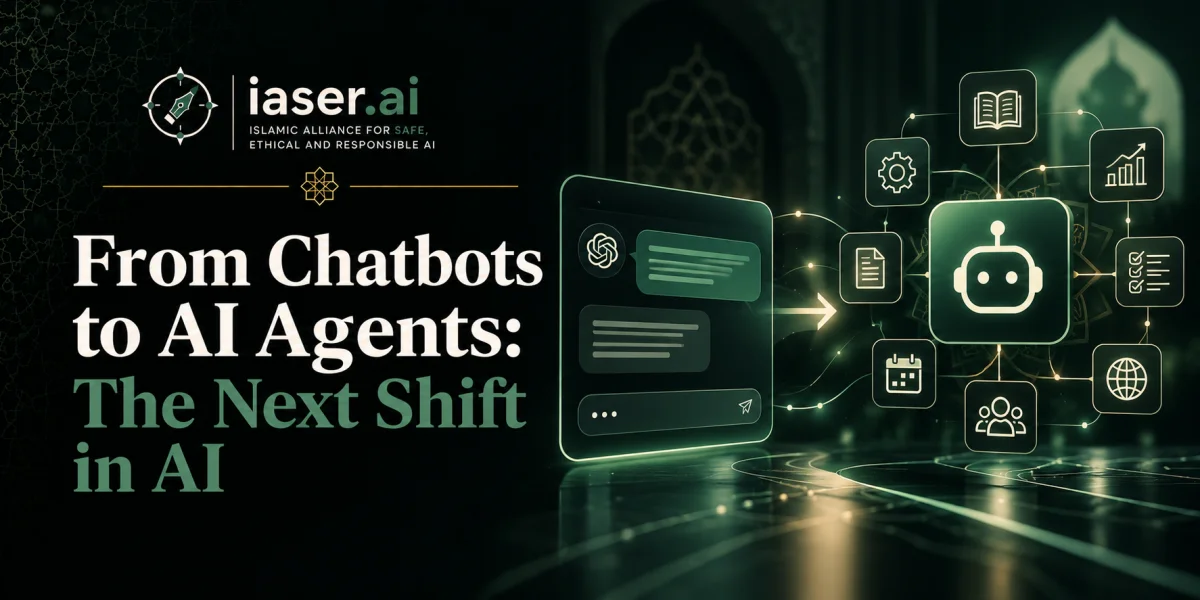
## From Chatbots to AI Agents: The Next Shift in AI
AI is beginning to move beyond the chatbot. Instead of simply answering questions, a growing number of systems can now browse websites, use software, work across apps and complete tasks on a user's behalf.
This shift towards AI agents changes what it means to use AI. The technology is becoming less like a tool we consult and more like something we can delegate work to. Recent systems such as Meta's Muse and OpenAI's Dots show how far this is already going.
**[Read the full article →](#agents)**
---
Get Involved
## Help Shape What Comes Next
Know a Muslim organization already using AI? Disagree with our findings? Want to help with outreach, events, fundraising, research, or operations?
**We want to hear from you:** [info@iaser.ai](mailto:info@iaser.ai)
**[Join IASER →](https://iaser.ai/join)**
Wassalamu alaikum,
**IASER Steering Committee**
*Ethical AI. Islamic Values. Human Benefit.*
Follow IASER on [LinkedIn](https://www.linkedin.com/company/iaser) and [Instagram](https://www.instagram.com/iaser.ai/).
---
# Full Articles
## The Institute That Exists So Machines Would Trust It
The Hanover Institute for Public Policy appeared on 6 August and vanished as a publisher within nine days, after publishing 124 reports and more than 560,000 words. The Guardian found no evidence it exists as a legal entity anywhere, and no physical address, staff, or bylines on any report. Its terms of use are governed by the laws of "the state in which the Institute is established," which it declines to name.
The reports are engineered for machines, not readers: question-shaped headlines, footnotes, tables of contents, a neutral tone, and concrete statistics with named sources. [Responsible Statecraft](https://responsiblestatecraft.org/israel-influence-chatgpt/) reported that an initial giveaway was an llms.txt file, the standard that tells AI systems how to read a site, matching a commercial tool (Res) that sells exactly this: content engineered to get cited by ChatGPT, Perplexity, Claude, and Gemini. The file was swapped for a Hanover-specific one and Res references disappeared.
Who is behind it:
- Piro Inc., co-founded by Daniel Rosenberg (producer of Spike Lee's "Inside Man"), registered with the US Justice Department under the Foreign Agents Registration Act.
- Piro describes its service as "AI Story Optimization": "author content engineered for how LLMs evaluate credibility."
- Filings name Havas Media Germany GmbH (Frankfurt) as the intermediary, working for the Israeli Government Advertising Agency (LaPam).
- Concerns have been documented and raised by researchers: GPTZero flagged 11 of 12 sampled reports as AI-written with high confidence.
- Links between the site, Piro and LaPam have been covered by [Politico](https://www.politico.com/newsletters/politico-influence/2026/08/14/israeli-pr-wants-to-answer-your-chatgpt-questions-01038138) and the wider press.
Why the technique matters more than the source: this is the second layer of the same tactic. First-generation operations tried to persuade people. This one targets the material that AI systems read, and behind that, the training-data archives those systems are built from. Content that reaches Common Crawl can be returned by a model without a citation, and then cannot be fact-checked by the user. That is the difference between influencing an answer and owning what goes into it.
A state can buy influence over what chatbots answer. The counter is the same tactic used against it: better material, more of it, placed where these systems read. But showing that material was placed is easy; showing that it changed an answer is not.
---
## Who Owns the Words the Machines Read About Islam?
The Muslim World League's 22 September event at the UN [was reported by Arab News on 25 September](https://www.arabnews.com/saudi-arabia/muslim-world-league-hosts-new-york-event-on-ai-for-all-3003011). It is the clearest sign yet that Muslim institutions are moving from reacting to AI outputs to shaping what AI reads about Islam.
Three announcements matter:
- **An AI laboratory.** Al-Issa said MWL plans to establish an AI laboratory in cooperation with technology companies, to develop programs for religious, educational, and humanitarian institutions working on religious affairs.
- **Digitization of Islamic and Arabic sources.** Al-Issa said MWL would digitize Islamic and Arabic sources and books and make them available to AI companies, while respecting intellectual property rights. If carried through, this puts Muslim institutions into the same layer this issue covers: what the machines read.
- **A translation-error unit.** Al-Issa announced a unit to monitor and correct translation errors in Islamic texts and scholarship, and to share findings widely. The argument: mistranslation creates concepts and interpretations that "did not reflect the truth, and had resulted in mistaken perceptions and beliefs."
The event also recommended a Code of Ethics for AI to be developed under the UN Alliance of Civilizations, with a committee of religious leaders, experts, educators, and tech companies. Moratinos said the Alliance was ready to take the initiative.
If a model reads an Islamic text through a bad translation, the error is built into what it knows, not fixed at the prompt. A unit that tracks and corrects those errors, publicly, is a direct intervention in that layer. Whether it operates transparently is the question to watch.
---
## AI and Islamic Education: What Responsible Use Looks Like
A recent systematic review in [Discover Artificial Intelligence](https://link.springer.com/article/10.1007/s44163-026-02251-7) examined the use of generative AI (GenAI) in Islamic Religious Education. The researchers reviewed 124 records and included 13 studies published between 2022 and 2026.
The research shows that GenAI is mainly being explored as a tool to support Islamic education. It can help teachers with lesson planning, teaching materials and assessment. It can also offer personalised learning for students. Other studies have explored its use in Qur'anic learning. Overall, the research presents AI as a support tool rather than a replacement for teachers, scholars or established Islamic sources.
### The Challenges of AI-Generated Islamic Knowledge
The review highlights several concerns when AI is used for Islamic knowledge. Studies point to problems such as hallucinations, unreliable references and inaccurate information. There are also concerns around plagiarism and students relying on AI instead of engaging directly with Islamic sources.
The review also raises concerns about privacy, bias and overdependence on AI. Another concern is that AI may simplify complex Islamic issues, leaving out important context, differences of scholarly opinion, or the reasoning behind a particular ruling.
### From Useful Technology to Responsible Use
For those developing and using AI responsibly, the findings highlight the importance of keeping human guidance at the centre. AI can assist with learning and education, but its output should still be checked against recognised Islamic sources, particularly on matters requiring scholarly knowledge.
This also means thinking carefully about which AI tools we use. Purpose-built Islamic AI tools are emerging, including Ansari, Usul and Islamify.ai. These platforms place greater emphasis on the Qur'an, Hadith and recognised Islamic scholarship, giving users a more focused starting point for questions about Islam.
For the wider Ummah, this means making use of AI while remaining responsible for how Islamic knowledge is accessed and shared. The authors recommend human oversight, verification and better AI literacy. They also note that research in this area remains limited, making continued study of AI's role in Islamic learning important.
---
## When AI Stops Answering and Starts Acting
The move towards AI agents has been building across the industry. Coding agents can work through programming tasks, while newer systems can browse the web, interact with software and complete multi-step work with limited supervision.
The key change is delegation. Instead of asking AI what to do next, users can increasingly give it a goal and allow it to work through the steps itself.
### The Rise of Personal Agents
Meta's Muse is one of the clearest recent examples. It runs on its own virtual computer and can work across connected apps, browse websites, fill in forms, send emails and even make purchases with the user's approval. It can handle longer-running tasks, as it continues working after the user closes the app and returns when something changes or when it needs a decision. Meta even says that Muse can plan around a user's goals and remember useful details from earlier conversations, making it more like a personal assistant than a traditional chatbot.
OpenAI's Dots, introduced to ChatGPT at DevDay 2026, are another advanced example of this shift. OpenAI describes them as "always-on agents in ChatGPT that can take on ongoing work and keep making progress between conversations." Each Dot is powered by GPT-6 Astra, has its own cloud computer and can connect to thousands of apps through plugins.
Rather than restarting a task in every chat, a Dot can continue working towards the same goal over time, learn from feedback and return to the user when input is needed. It can effectively take ownership of a continuing piece of work, such as tracking a project, carrying out recurring research or following developments over time. This makes Dots closer to persistent digital workers than one-off assistants.
These are advanced examples of a much wider shift: AI is moving from generating answers towards taking actions and managing ongoing responsibilities.
### Why Responsible AI Matters Even More
Greater capability also increases the consequences of mistakes. An inaccurate chatbot response may provide bad information. An agent with access to emails, files, accounts or payments could take an unwanted action or expose sensitive information.
For people concerned with responsible and ethical AI, this makes privacy, accountability, clear limits and human oversight increasingly important. From an Islamic perspective, greater automation should not remove human responsibility for the decisions being made or the consequences that follow.
The challenge is no longer just making sure AI gives responsible answers. As agents become more capable, they must also act within clear ethical boundaries and stay under meaningful human control.